I’ve written about this before, but I often see sentiments like the one in the below photo posted in philosophy forums and so I compiled a more specific response to this type of thinking:
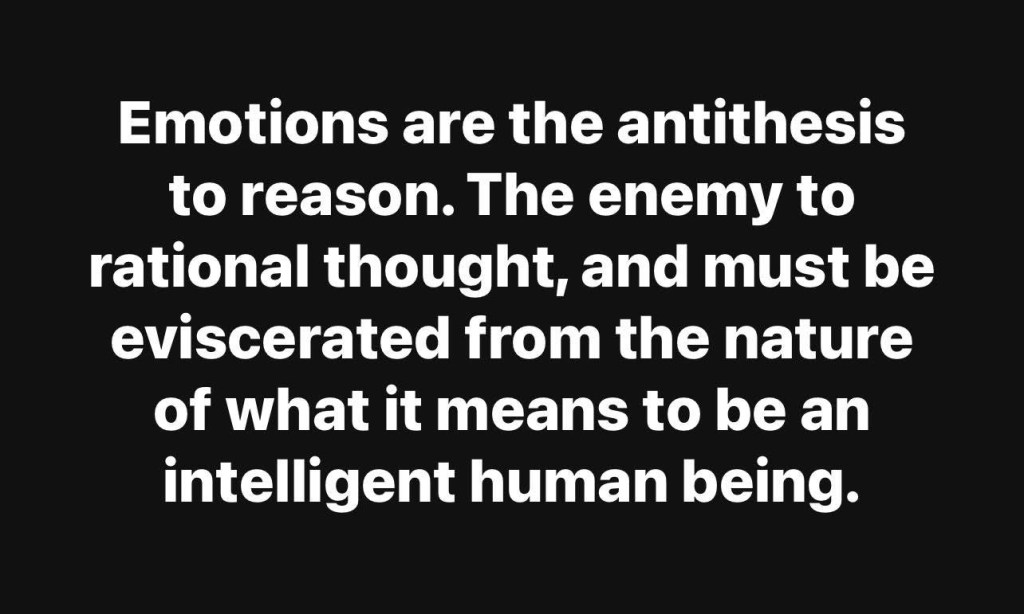
That’s a misunderstanding of what emotions are. Emotions aren’t some enemy to reason, they are reason in action, just in a faster, less visible form. Emotions are heuristics. You can’t sit down and calculate every variable consciously, so your brain uses rough-cut algorithms shaped by evolution, environment, past experience. Every emotion is a quick signal: move toward this, move away from that, take this seriously, ignore that. You can refine them, retrain them, blunt them, but you’ll never escape them completely. Even the person who prides themselves on pure logic is just following a cooler, more abstract emotional drive, seeking control or coherence or some imagined ideal of order. Strip away emotions entirely and there’s no reason left to care about anything, no impulse to act at all. You’d just sit there, blank.
To elaborate further, there’s a book called Algorithms to Live By by Brian Christian and Tom Griffiths, and in it they describe how decision-making problems like the secretary problem, explore-exploit trade-offs, and optimal stopping mirror challenges humans face in real life like choosing a mate, picking a job, deciding when to settle. What’s notable is that these same mathematically optimal strategies map surprisingly well onto how emotion seems to function as an evolutionary tool. Emotion is not random noise or interference, it is a heuristic system that motivates behavior along lines that resemble these algorithms.
For example, the optimal stopping problem suggests looking through a set number of options, about 37%, before making a choice. That maps onto how people often date for a period in early adulthood, then settle down around a statistically predictable point. Emotions like anxiety, regret, or FOMO push people to act in accordance with that stopping rule, helping them move from exploration to commitment.
Another example is the explore-exploit trade-off. Early on, it’s better to explore, whether that means dating different types of people or sampling various careers. Later, it’s better to exploit what you’ve learned and stick with the best option. Emotion again acts as the motivator, curiosity early on, then attachment and fear of loss later. You don’t consciously run the math, but the feelings you experience are nudging you toward behavior that lines up with what game theory and evolutionary theory predict would lead to better outcomes.
So when people say emotion clouds judgment, I tend to see it the opposite way. Emotion is the mechanism for applying evolutionary algorithms honed over thousands of generations. It’s an old operating system, sure, but one optimized for survival and resource management, not raw logic. Algorithms to Live By just puts numbers and models around what nature had already wired into us emotionally.
That does not mean there is no role for System 2 thinking, but people tend to overestimate both its power and its purpose. We like to imagine that rational analysis sits at the helm of decision-making, carefully weighing pros and cons. In reality, much of what feels like deliberate thought is post hoc rationalization, a story we tell ourselves and others to justify choices already made through emotional and heuristic processes. System 2’s main function may not be making decisions at all, but explaining them in a way that helps build consensus, signal competence, or secure resources and allies. Emotion and heuristics do the heavy lifting, and System 2 cleans up after the fact, often convincing even ourselves that we were rational all along.
This also holds true for moral reasoning for which both the primary fuel and method of expression for emotions. And thus, while in the spirit of emotivism, moral statements are at their core just emotional preferences, what exactly do you think reason is riding on top of? Again, emotions are heuristics. They’re fast, evolved shortcuts that coalesce over millions of years of environmental conditioning, and moral norms are just the cultural-level fossilized patterns of those heuristics. And that’s because emotions are a manifestation of a complex, algorithmic logic honed by natural selection. We share similar moral reasoning because we share similar biology, genetic history, and evolutionary pressures. Our emotions are not random, they’re functional outputs of an adaptive system. It’s still logic, and it’s still purposeful. Just because it’s run by emotion doesn’t make it random or wholly relativistic.
Seeing emotion as separate from reason misses the point. Emotion is not what gets in the way of thinking clearly, it is how we think clearly when time, energy, or information is limited. It’s the scaffolding beneath conscious thought, shaped by selection and sharpened by necessity. The mistake is assuming that because it feels automatic, it must be irrational. In reality, most of what we call logic is just a slower, more verbalized way of navigating the same terrain.
Often, logic itself is little more than post hoc reasoning layered on top of emotional heuristics. We feel first, act second, and justify last. The story comes after the decision, not before. Even our most elaborate systems of rational thought are often backfilled explanations meant to satisfy social, internal, or ideological coherence. The emotional algorithm moves first, and the logic gets built around it to make it legible.
So rather than dismissing emotion or moral intuition as subjective noise, it’s more accurate to see them as evolved strategies embedded deep within us, organizing behavior in ways that approximate optimal outcomes. The language we use to describe these processes is always going to be a step behind the processes themselves, because it’s trying to explain from the outside what’s already been decided from within.
None of this makes emotion infallible, but it does make it indispensable. If we want to understand ourselves, or improve the way we think, we need to stop pretending emotion is the problem. It’s the operating system. Everything else is just the interface.
 Sentient Roomba